MTAM

For the development of management teams and boards.

For Management Teams

For those leading or being a member of a management team, the feeling of needing to contribute more may arise. Management team work is often characterized by different opinions and perspectives, and members often wish there was more alignment in their work. What’s important is that the management team has the capabilities to meet the demands of the mission.

Using MTAM as a mapping tool for the management team's capabilities is therefore invaluable. MTAM helps management teams start a concrete development process where the team improves its ability to collaborate and becomes a professional management team.

MTAM [Management Team Assessment Model]

It starts with the management team. In a well-functioning management team, members build consensus around the what (the thing to be done), the why (the purpose for doing it) and the how (the strategy for getting it done) of each issue.Each member is also a link between the management team and the next link in the chain. The most important task of each link is to generate trust, commitment and participation around the issue at hand.

In order for an organisation to succeed, the management team needs to be successful at addressing the right issues and dealing with them in a way that is beneficial to the organisation. The scientifically developed MTAM tool helps management teams to identify their current capability and to create a plan for how they will develop towards the level needed to fulfill their purpose. Certified MTAM consultants lead and facilitate this development process.

Prior to the 1980s, management teams were not used in the same way that they are today. The phenomenon of the management teams is therefore both new and also entirely commonplace. That they are new means there is limited research, experience and tools for development available. That they are commonplace means that ‘all’ organisations use management teams, but that very few understand how they are intended to work. Based on the clear need that emerges from this, the Management Team Assessment Model was developed in 2007 to be used as a development model and evaluation tool.

Development with the support of MTAM always takes place in process form. Each group takes three measurements, providing an initial value, a value describing how far the group has come along in the process, and a final value showing the group's new capability. Direction and interventions are thus continuously adapted to the actual needs of the group. According to users, the model is interesting, enjoyable and exceptionally stimulating.

Capability emerges from the interplay between the what and the how

The measurement consists of questions which are based on these two dimensions and on seven underlying factors. Taken together, they provide a good picture of how group members perceive the ability of their group to work together and to deal with issues that affect the whole business rather than just its parts.

Measuring Effectiveness & Collaboration

Each management team receives a unique current situation as the foundation for their development and continued collaboration.

From Current State to Desired State

A certified consultant helps the management team develop based on their needs, which creates successful collaboration.

For Boards

There are several reasons why boards should evaluate their own work. First and foremost, it demonstrates good governance and accountability. Evaluation facilitates learning and ultimately increases the effectiveness of the board's work.

Often, it turns out that the board has completely different views on how effective it is or which issues it handles best. Measurement is therefore crucial to initiate concrete development work.

BAM [Board Assessment Model]

BAM [Board Assessment Model] has been specifically developed for the board. BAM enhances the board’s efficiency and transparency towards the organization and external stakeholders. Just like MTAM, BAM is both an evaluation tool and a development model.

Overall, the measurement shows the board’s collective effectiveness and collaborative ability. Thus, each board receives a unique baseline as a starting point for its development and continued collaboration.

The questions are based on self-assessment and focus on how the work functions within the board.

Development Work

A certified consultant helps the board move from its current state to the desired state. Since the board itself determines what it needs to develop, the development work becomes a collaboration between the management group and the consultant, which promotes successful development.

If you would like to learn more, please contact us.

Get Certified

As a consultant, contributing to the development of a management group requires both experience and insight. Through our certification, you will gain the tools and methods needed to work professionally with MTAM and lead development processes within management groups.

Certification Process in Three Steps

Step One 01

During a full-day session, we meet in a qualitative group to learn about the research on management teams, build an understanding of MTAM, study example groups, and practice as well as review how the consultant manages and administers tools and measurements.

Step Two 02

Conduct your own measurement of a selected management team. With support from the course leadership, you will then interpret the results and prepare how to provide feedback to the management team.

Step Three 03

Follow-up reflection and check-in with the course leadership.


Once all steps are completed, you will be licensed as an MTAM consultant and gain access to the necessary tools for conducting future measurements.


Location and Practical Information

We conduct certifications at central locations and will provide more detailed information before the training session. The course literature The Management Team by Otto Granberg and Harry Wallenholm is included.

Why Get Certified in MTAM?

MTAM provides you, as a consultant, with a clear structure for facilitating the development of management teams. The method not only increases the group's engagement and effectiveness, but also makes it easier to sell your consulting services and build long-term partnerships.

Certification enables you to work strategically with development processes and conduct measurements in three steps to ensure long-term improvement in the management team’s work.

The science behind

The tool itself is a set of questions. The questions are developed abductively and evaluated statistically. The questions are based on a self-assessment model and concern the functioning of the management team. Overall, the measurement produced is an indication of the management team's collective effectiveness and ability to work together. This gives each management team a unique understanding of the current situation which can be used as a starting point for the streamlining and professionalisation of its work.

The survey

The psychometrically quality-assured MTAM survey is used to see how the management team is doing. The survey consists of 43 questions and is answered online. None of the results returned to the business will be attributable to the individual respondents.

Development work

A certified consultant facilitates the management team in moving from their current situation to their desired situation. As it is the management team itself that decides what it needs to develop, the development work is organised as a collaboration between the group and the consultant.

The MTAM model

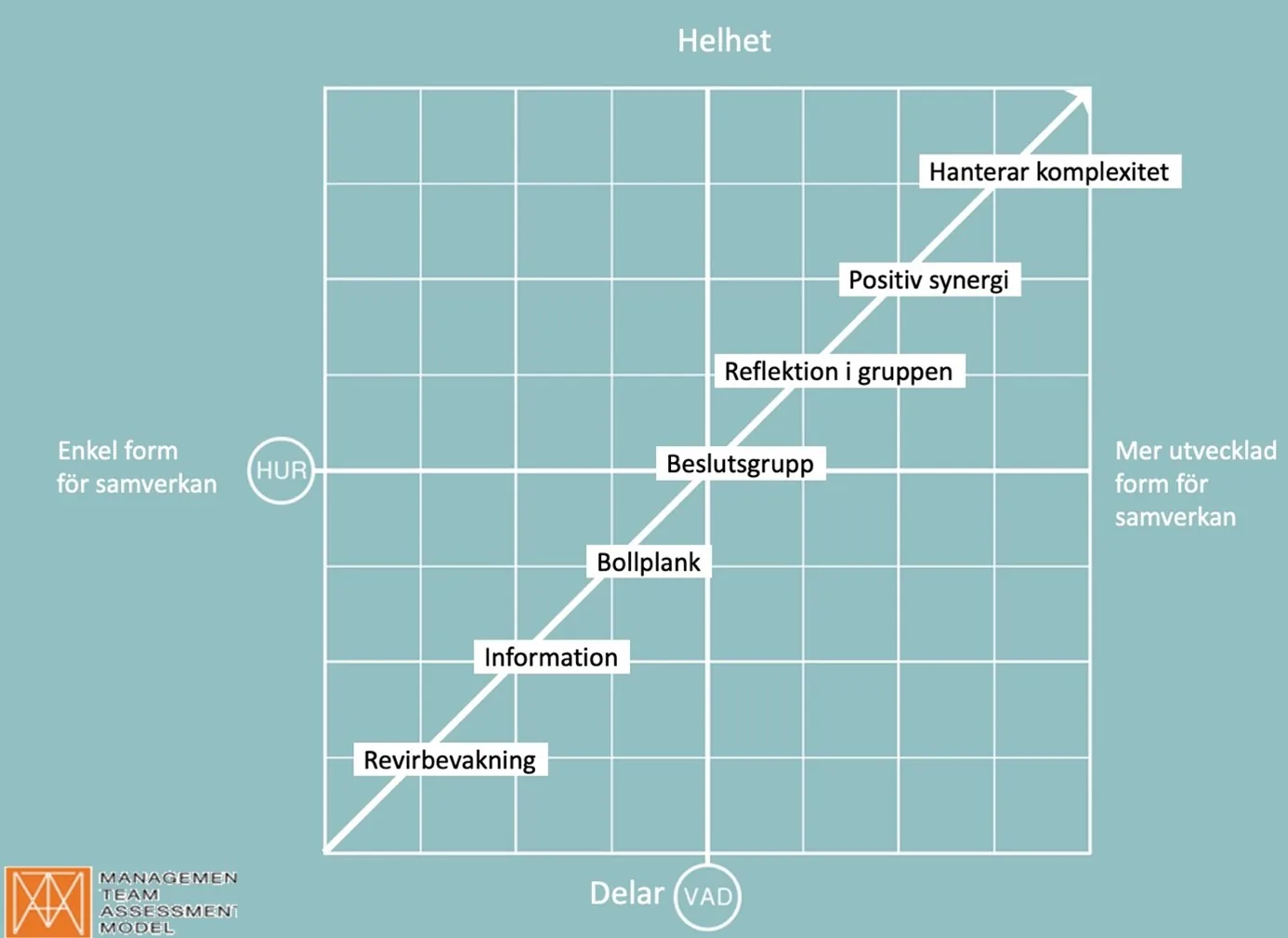
At the lower left end of the scale are management teams that might do ok, so long as the issues at hand are not too difficult to handle. One example of this is groups in which members largely work on individual parts of the business and can manage a simple form of collaboration. These are often characterised by turf protection, with each member looking out for the best interests of their own specific sub-sector.

The upper right part of the scale shows the level of ability required to manage complexity. The ultimate example of this is groups that are able to manage complexity by, among other things, considering the whole picture and developing explicit strategies, as well as ensuring that the individual carries the competence of the leadership team.

Diagram with grid and diagonal arrow from bottom left to top right.
                                      Stages: Territoriality, Information, Sounding board, Decision group, Group reflection, Positive synergy, Handling complexity.
                                      X-axis: 'Parts (What)'. Y-axis: 'How', with 'Whole' at the top.
The MTAM model: a developmental line from simple collaboration (What/parts) to holistic focus (How) and the ability to handle complexity.

MTAM Measurement Results

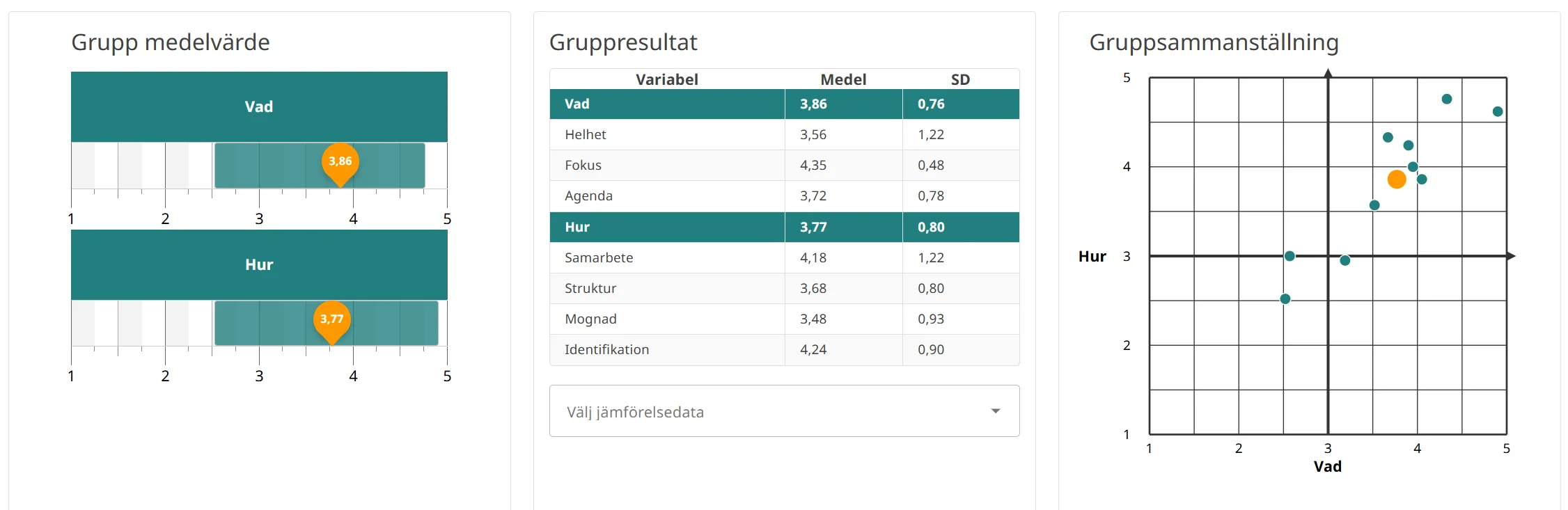
The survey results are presented in three different pictures which form the basis for the management group's insights into the current situation, thereby helping the group to envision its desired situation.

The group average value shows the mean of the what and the how on a scale from 1 to 5. This picture also shows the difference between the extremes in terms of how members view the group.

The group result shows how far the group members think the group has progressed on average in its development. This mean should be read alongside the standard deviation (SD) which shows the degree to which the group members agree on the mean value. It is the combination of the mean and the standard deviation that forms the central basis for the production of the development plan.

Three visualizations of the MTAM survey: means for What and How, a table showing the subscales' means and standard deviation (SD), and a scatter plot where the orange marker shows the group mean in relation to the individuals' values.

About Us

The MTAM Group was founded in 2007 by Otto Granberg, PhD, Monica Bjerlöv, PhD, and John Ylander, PhD, with the aim of developing a psychometrically validated method to clarify the relationship between a management team's unique conditions and their capabilities.

This work resulted in MTAM [Management Team Assessment Model], which is based on a questionnaire and a pedagogical model that provides management teams with unique support for their development work.

In recent years, the model has been developed to include an application for boards called BAM [Board Assessment Model], which is also based on a set of questions and a pedagogical model that provides boards with academically quality-assured support in their development work.

Frequently Asked Questions

FAQ

?

Within which types of organisations is MTAM appropriate to use for development?
In all types of organisations – public, private, non-profit, etc. If there is a group that is responsible for the whole of the organisation rather than just its parts, then MTAM can be applied regardless of whether that group is a board, a management team or another group with similar functions.
How reliable is MTAM?
The short answer is that it is very reliable. Measuring individuals is difficult, and groups even more so. MTAM is at the forefront of both measuring the right things and measuring them right.
Have management teams been observed to develop with the help of MTAM?
Yes, based on the last 18 years of work, we can practically guarantee an increase in the group's capacity by at least 20 percentage points. For most groups, this will make a decisive difference to the success of the business.
Isn't it a good thing that members of a management team or board have different opinions?
Yes, the whole point of this type of qualitative group work is to generate awareness around different perspectives. It is for this very reason that a systematic approach is needed – in order to leverage these different perspectives and build the capacity of the team to address issues and decisions at the level of complexity required by the business.
What does MTAM measure?
MTAM measures each member's perception of the group's capabilities across seven variables. Thus, it is always the group itself that is measured and not the behaviour of its members. This means that all members are eyewitnesses to the same group and it is therefore of considerable value to look at both the mean and the standard deviation in order to determine the group's current ability.
What is standard deviation?
Standard deviation (SD) is a measure of how the extent to which values in a data set deviate from the mean on average. The larger the SD, the more dispersion in the data and, in the case of MTAM, the less consensus on the management team/board.
What is maximum standard deviation?
The maximum standard deviation (SD) depends on how the values are distributed. This means there is no absolute maximum value without knowing the range and number of data points. In general, the SD is highest when the values are as far from the mean as possible within the given range.
Are there any advantages to being a certified consultant in public procurement?
In recent years, more and more organisations require their consultants to be MTAM certified. These demands are increasingly being made in the state, regional and municipal sectors.
How do you become a certified MTAM consultant?
There are four people authorised to train and certify MTAM consultants. In addition to John Ylander and Christian Sandblom, these are Malin Larsson and Jörg Bassek, with the latter being mostly responsible for the German-speaking market. Read more here:
How many MTAM consultants are there?
There are about 150 certified MTAM consultants and work to update the licences is currently ongoing to ensure that all will be updated to the new standard that applies from 2025.